Water Conservation in the RDOS
Looking for the water restriction stage in your neighborhood? Head over to the main RDOS Water Restrictions page here:
https://www.rdos.bc.ca/utilities/water-systems/water-restrictions/
📰 News & Announcements
Water Scarcity is a lack of available water for human or ecological needs. Water scarcity is often introduced or made worse by drought but can also occur in the absence of drought. The level of scarcity is determined by specific local data, water demands, local storage capacity, Indigenous watershed knowledge, environmental sensitivities, and management priorities of an area.
The Water Scarcity Index for the Southern Interior is at the highest possible level due to the severe ongoing drought. This may result in requests for additional water conservation, higher water restrictions, and increased messaging around responsible water use.
Ongoing severe drought conditions in the Okanagn and Similkameen continue to remain unchanged and are unlikely to change in the coming months. Small snowpack, severe rainfall shortages, and lowering groundwater stores are all contributing to conditions that have not been seen in many decades in this region.
Stay Gold, RDOS!
The Regional District of Okanagan-Similkameen (RDOS) is encouraging residents to conserve water this summer by embracing a natural, water-wise landscape through the launch of the Stay Gold Water Conservation Contest, running from June 1 to August 15, 2026.
The contest invites residents served by RDOS-owned water systems to let their lawns turn golden during the hot summer months and submit a photo for a chance to win prizes. Each participating water system will award its own set of prizes, including $100 for first place, $50 for second place, and $25 for third place.
Water conservation remains a shared priority across the region, particularly during the summer when outdoor watering can account for a significant portion of household water use. By reducing lawn watering, residents can help preserve water supplies for essential uses, protect local ecosystems, and support long-term water sustainability.
Approximately one inch of water per week (on the days and times permitted by current water restrictions) promotes deep and healthy root growth and increases a lawn's drought resilience. Although a dormant lawn isn't actively growing, it does need to be mowed infrequently to ensure it stays tidy.
In addition to saving water, allowing lawns to go dormant can:
- Reduce water bills and overall water demand
- Support drought resilience in the community
- Encourage healthier, more sustainable landscaping practices
Residents can enter the contest by submitting a photo of their dormant lawn in the form linked above. Alternatively, email your golden lawn photo to utilities@rdos.bc.ca with the subject line “Stay Gold – YourWaterSystem” with your name and address.
Conserving water and staying FireSmart:
Letting lawns go golden does not mean creating unsafe conditions. Dormant grass is simply in a temporary resting state during hot, dry weather and can recover when cooler conditions return. At the same time, residents are encouraged to maintain their properties using basic upkeep such as occasional mowing and removing dry debris.
The RDOS is also encouraging residents to follow FireSmart™ principles, focusing on fuel reduction near structures rather than relying on irrigation. This includes measures such as keeping grass trimmed to a FireSmart-recommended height of 10 cm or less and maintaining clear space around homes. These actions help reduce wildfire risk while still conserving water.
Everyone’s property and comfort level will be different, and participation in the contest is completely optional. Residents are encouraged to make choices that work for their household.
💧All About Water
Click through the tabs below to learn more about water management, drought, and water conservation in the RDOS.
Don't see your question answered here? Ask us! (See contact info in the side bar)
🚿Water Conservation & Restrictions
To put it simply - water doesn't flow uphill!
Even though there are billions of litres of water contained in the lakes and rivers within the RDOS, this abundance of water does not simply flow directly to household taps. Most RDOS systems do not even use these lakes or rivers as a water source and are instead supplied by wells tapped into underground pools called aquifers. Bringing water from the environment to a house and making it safe to drink requires several different stages of infrastructure, and there is a limit to much and how quickly these systems can process that water. In summer, the increased demand for water often greatly outpaces how quickly these small system can work, which puts strain on system components.
Water restrictions ensure the demand for water stays at a manageable level to ensure the systems can keep up.
Even though the average household uses almost four times the amount of water outdoors than indoors, it doesn't mean that indoor water savings aren't important! Here are some ways to reduce your use inside the house:
- Only run dishwashers and laundry machines with full loads.
- Turn the tap off every time it is not in direct use (i.e. don’t leave it running while brushing teeth or doing dishes).
- Switch old toilets for low flow models if budget allows, or add displacement bladders to the tank so less water is used per flush.
- Take shorter showers instead of baths.
- If purchasing new appliances, look for the Energy Star rating for maximum water savings.
FAQ
⛲Leaks & Water Systems
Irrigation systems are one of the most common leak sources and can also waste the most water. If you suspect that your irrigation system has a leak, call the Utilities department and request a "deep read" your meter. This is an in-depth meter reading that will show hourly water usage for the entire previous quarter. In order to isolate the leak and create a pattern in the meter read that shows which zone the leak may be in, it is strongly recommended to do the following protocol:
Note: The entire protocol may not be possible depending on the system set up. At minimum, step 1 must be completed to at least isolate the irrigation system as a whole.
- Turn off the whole irrigation system at the main system shutoff for at least 2 hours. This stops any water from getting to the potential leak and creates a clear marker on the meter readout. If possible, try not to use water in the house at this time.
- Manually set the system so that the sprinklers will not run when the system is turned on. Some systems have sprinkler heads that can be closed, other systems may require digging to the main control box to manually close the zone valves. Still others may be able to electronically control the zones and sprinklers seperately.
- Turn the system back on, and open Zone 1 for 1-2 hours. Do not allow the sprinklers to run.
- Open Zone 2 for 1-2 hours. Do not run the sprinklers.
- Repeat the above step for all remaining zones.
- Mark the time you finished, and then readjust the system to run properly on its normal schedule.
Turning on each zone separately without running the sprinklers will isolate which zone(s) have a leak, as the meter readout will show water running when the leaking zone is opened, even though there should not be any running water with the sprinklers off.
If you know there is a leak somewhere in your irrigation, but are unable to isolate the zone, it may be worth calling professional irrigation company for assistance. They likely have specialised equipment for leak detection, such as acoustic listening devices.
Irrigation systems are one of the most common leak sources and can also waste the most water. In order to isolate the leak and create a pattern in the meter read that shows which zone the leak may be in, you can try the following protocol
Note: The entire protocol may not be possible depending on the system set up. At minimum, step 1 & 2 must be completed to at least isolate the irrigation system as a whole. During the protocol, ensure water is not being used in the house. No dishwashers, laundry machines, icemakers, etc. Ask that other members of the household refrain from using any water for an hour or two.
- Locate and check your meter. Is it running even though nobody is using water and the sprinklers are not on? This is how you know there is a leak.
- Turn off the whole irrigation system at the main system shutoff. Check your water meter - it should have stopped moving. If it is still moving, the leak is not in your irrigation system. Read the section titled "Indoor Leaks". If the meter has stopped running, proceed to Step Three
- Manually set the system so that the sprinklers will not run when the zones are turned on. Some systems have sprinkler heads that can be closed, other systems may require digging to the main control box to manually close the zone valves. Still others may be able to electronically control the zones and sprinklers separately.
- Turn the main shutoff back on, and open Zone 1 only. Do not let the sprinklers run. Check your meter. If it is running, this zone is where your leak is located. If the meter is not running, proceed to Step Four.
- Open Zone 2 without letting any sprinklers run. Check your meter. If it is running, this zone is where your leak is located. If it is not running, proceed to Step Six.
- Repeat the above step for all remaining zones.
- Readjust and reset the system to run properly on its normal schedule.
If you know there is a leak somewhere in your irrigation, but are unable to isolate the zone, it may be worth calling professional irrigation company for assistance. They likely have specialised equipment for leak detection, such as acoustic listening devices.
When reading your quarterly water bill, you may notice an alert about a leak detected in your water system. An intermittent leak is one that appears and disappears for hours at a time during the month. This is in contrast to a continuous leak, which is a leak that doesn't stop flowing for days.
If you were notified about an intermittent leak, this means that there were many days where your meter detected nonstop water flow for hours at a time. Many things can cause an intermittent leak. Some examples of what can trigger an intermittent leak notice include:
- A degrading or loose flapper in a toilet flush mechanism that briefly leaks for a while but fixes iteslf a few flushes later
- A drippy garden hose that is sometimes turned off at the house, but sometimes not.
- A faucet or shower that has a drip, but is sometimes turned off tightly enough that the drip stops for a while.
If you were notified about a continous leak, this means your meter has detected flowing water 24 hours a day for days at a time. Continuous leaks are more serious, as they can consume hundreds of litres per day depending on the source. Common sources of continuous leaks are:
- Outdoor water systems. This is by far the most common source for water leaks. If you think you may have a outdoor leak, please check out the section on irrigation leaks.
- Toilets. These can be silent, but are very easy to investigate. To check for a toilet leak, drop food colouring in the tank and wait 15-30 minutes. If colour shows up in the bowl, you have a leak.
- Drippy faucets and showers
- Bring the pool water to its normal level.
- Fill an empty bucket with pool water to about one inch from the top of bucket. (By filling the bucket close to the top you're ensuring that air movement over the surface of the bucket will be similar to that of the pool.)
- Place the bucket on the first or second step of the pool. (To keep it from floating away it may be necessary to place a brick or a few rocks into the bucket.) By placing the bucket in the pool water you're ensuring that the water temperature of each will be similar.
- Mark the water level inside the bucket.
- Mark the water level of the pool on the outside of the bucket.
- Operate the pool for 24 hours in the same way it was operating when a leak was first suspected.
- After 24 hours, compare the water levels in the pool and the bucket to the marks you made on the bucket. If the pool water level has dropped more than the bucket water level, there's probably a leak
FAQ
🏜️Drought & Water
The approaching “super El Nino” weather pattern has been all over the news lately. It is very likely that our region is going to experience another warmer, drier winter similar to last year. While this may be pleasant on a day-to-day basis, warm temperatures mean a good snowpack is unlikely. Snowpack, and the subsequent spring melt or ‘freshet’, is what fills upland storage reservoirs, seeps underground to replenish aquifers, and supplies a continuing stream of water until the snow is finally gone from mountain peaks in early summer. With little to no snow, as is predicted for this season, this annual water refill cuts off weeks to months earlier. Reservoirs are drawn down earlier, aquifer levels drop sooner, and water scarcity gets higher and higher.
Even though there may still be a seemingly large amount of water flowing through a stream, there is a certain depth (called an Environmental Flow Need, or EFN) that fish need in order to survive.
When there is too little water in a stream, it can lower the amount of oxygen in the water available to fish, reduce the amounts of aquatics bugs and other food sources, and also simply become too warm for the fish to survive. The EFN is the minimum amoutn of water needed for the fish and their habitat to continue functioning properly. When the water levels drop below the EFN, fish die-offs can start, and the overall quality of the habitat for other aquatic life starts to become severely impacted.
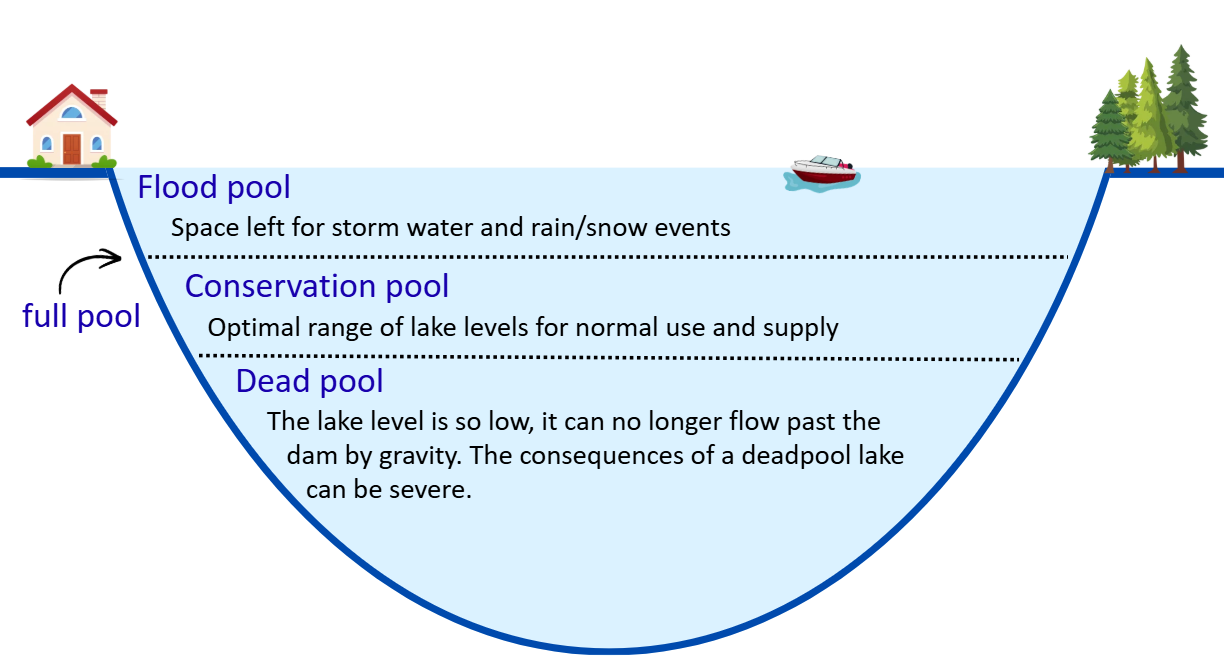
Full Pool means that a managed lake such as Okanagan or Osoyoos Lake has reached its maximum fullness before beginning to spill over its managed dam height. Full Pool is the lake level that leaves the optimal amount of water for all water uses (e.g. agriculture, recreation, etc) to have enough water throughout the year.